
Terry Pratchett
.
28th April 1948 – 12th March 2015
Terence David John Pratchett was born to David and Eileen Pratchett on the 28th April 1948, at Minellan Nursing Home in Beaconsfield, Buckinghamshire. He grew up to become the UK’s best-selling author of the 1990’s and is known globally as the creator of the Discworld fantasy novels, a series numbering 40 volumes. His 2011 Discworld novel ‘Snuff’ was at the time of its release the third-fastest-selling hardback adult-audience novel since records began in the UK, selling 55,000 copies in the first three days. He was also a famous campaigner for Alzheimer’s research and for the human right to choose a ‘good death’.


After passing his 11-plus in 1959, he attended High Wycombe Technical High School rather than the local grammar because he felt ‘woodwork would be more fun than Latin’. At this time he had no real vision of what he wanted to do with his life, and remembers himself as a ‘nondescript student’, but he had a keen interest in radio. He and his father belonged to the Chiltern Amateur Radio Club in the early 1960’s, their joint handle being ‘Home-brew R1155’. It was from this that Terry’s interest in computers grew – when a transistor cost a week’s pocket money and you built things like a radio around one. At school, his writing talent was recognised by one of his teachers, and he was fourteen when he first appeared in print.
His short story ‘Business Rivals’ was published in the December 1962 issue of the Technical Cygnet, and nine months later, much enlarged, it was published as ‘The Hades Business’ in the August 1963 issue of Science Fantasy. With the proceeds from this sale he bought his first typewriter. Terry was now in line for a bright future. Having earned five O-levels and started A-level courses in Art, History and English, he decided after the first year to try journalism. When a job opportunity came up on the Bucks Free Press, he left school in 1965, to the sorrow of among others, the school’s Senior Debating Society, its Secretary reporting in the Cygnet: ‘Regrettably, Pratchett’s premature departure has meant the loss of one of our greatest characters.’


While with the Press, Terry still read avidly, taking the two-year National Council for the Training of Journalists proficiency course (and coming top in the country in its exams). He then passed an A level in English, whilst on day release. He married Lyn Purves at the Congregational Church in Gerrard’s Cross in October 1968, by which time he had interviewed Peter Bander van Duren, one of the directors of publishing company Colin Smythe Limited, for the Bucks Free Press about a book he had edited. At this time Terry mentioned to Peter that he himself had written a book called The Carpet People and, discovering the book to be a gem, Terry was offered a contract, which he accepted and signed. And seeing how good an illustrator he was, the publishers also asked him to illustrate the book. Over the next year Terry produced about thirty illustrations and the book was published in November 1971.
Terry left the Buck Free Press for the Western Daily Press on 28th September 1970, but he returned to the Press in 1972 as a sub-editor. On 3rd September 1973 he joined the Bath & West Evening Chronicle.
Terry and Lyn’s daughter Rhianna was born in 1976, and many of his books have been dedicated to her.
In 1983 The Colour of Magic was published to great acclaim and The Light Fantastic followed in 1986, by which time it had become obvious that if Terry was to maximise his potential, he had to move to a major hardcover publishing house.


Victor Gollancz’s SF list was very well known and respected, and three titles were quickly published, Equal Rites, Mort and Sourcery. In September 1987, soon after he had finished writing Mort, Terry decided that he could afford to devote himself to full-time writing. He thought he may suffer a drop in income for a while but that it would pick up in due course – and anyway, he enjoyed writing more than fielding questions from the Press about malfunctioning nuclear reactors! So he resigned his position with the CEGB and his sales – and income – picked up very much more quickly than he expected. His next Gollancz contract was for six books, with much larger advances. Gollancz also signed up Faust Eric, a novella illustrated by Josh Kirby.
Terry’s collaboration with Neil Gaiman, Good Omens, was published in May 1990. Late in 2007 the Costa Book Awards carried out a survey of the most re-read books, and Good Omens came fifteenth, ahead of The Bible and The Hitchhiker’s Guide. This brilliantly dark and screamingly funny take on humankind’s final judgment was hugely popular and a new hardcover edition is now available (which includes an introduction by the authors, comments by each about the other, and answers to some still-burning questions about their wildly popular collaborative effort).
Also in 1990, Clarecraft Designs, a company in Suffolk, founded by Bernard Pearson, was licensed to produce a series of models of Discworld characters, and before it closed in 2005 it had produced over 200 figurines, many of which were also produced as pewter miniatures. In October 2008 the Polish company, Micro-Art Studios, began producing Discworld miniatures under licence, based on Paul Kidby’s illustrations. As Discworld grew in Terry’s imagination, so did the complexity of the city of Ankh-Morpork, and Stephen Briggs, with Terry’s input, set about creating a street map of the city mostly based on the descriptions of the activities of Samuel Vimes and the City Watch.

Terry’s twenty-second Discworld novel (and first hardcover to be published by Transworld’s Doubleday imprint) – The Last Continent (definitely not about Australia, but ‘just vaguely Australian’) – was published at the beginning of May 1998 and was twelve weeks in the no.1 position in the hardcover fiction best-seller list in Britain. The next, Carpe Jugulum, in which the witches battle vampires for the Kingdom of Lancre, was published on 5th November and it and the paperback edition of Jingo (published on the same day) jointly held the no.1 positions in the hardcover and paperback fiction lists for four weeks running

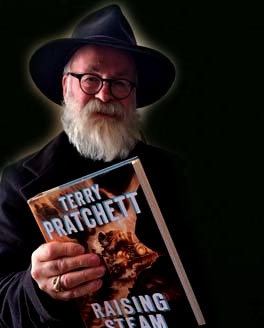
As far as Britain was concerned Terry was the 1990s’ best-selling living fiction author. His sales now ran at well over three million books a year. In 2001, it was reported that during the first 300 weeks’ existence of the British Booktrack’s weekly bestselling chart, over 60 titles had continuously been in the top 5,000 bestselling titles and the author with the most titles in this listing was Terry with twelve; The Colour of Magic, Guards! Guards!, Pyramids, Soul Music, The Light Fantastic, Reaper Man, Interesting Times, Sourcery, Men at Arms, Equal Rites, Mort and Wyrd Sisters. No other author had more than one. The Bookseller’s article announcing this fact therefore crowned him ‘Evergreen King’. In 2003 the BBC Big Read showed Terry as having as many titles in the top 100 best-loved books – five – as Charles Dickens.
Terry’s work for the Orangutan Foundation is common knowledge. In 1995 he travelled to Borneo with a film crew to see orangutans in their native habitat, and among the praise that ‘Terry Pratchett’s Jungle Quest’ received was a comment by Sir Alec Guinness in his diary (published the following year), that it was – apart from one other programme – ‘the most impressive thing I’ve seen on the box this year’. In April 2012 Terry and his assistant Rob Wilkins travelled once again to Borneo to revisit the Orangutan Foundation and see what had happened since Terry’s last visit. It resulted in a new documentary, Terry Pratchett: Facing Extinction, filmed by Charlie Russell and shown on BBC1 TV on 27th March 2013.


A two-part four-hour dramatized mini-series adaptation of Hogfather (by Mob Films) was transmitted in December 2006. It was filmed as live-action with CGI, with the late Ian Richardson as the voice of Death, Sir David Jason as Albert, Marc Warren as Teatime and Michelle Dockery as Susan. Filming the snow scenes took place in February 2006 in Scotland and main filming was completed at the Three Mile Studios in London, with the CGI being created by the Moving Picture Company. In April 2007 it won a BAFTA Interactivity Award. Sky invested more in this production than in any previous they’d commissioned, and their confidence was more than justified by the viewing figures of 2.8 million for this £6 million project, making it the highest rated multi-channel commission ever (to that time), beating BBC3’s October 2006 figures for Torchwood.
Sir David Jason, Tim Curry, Sean Astin and Christopher Lee (as the voice of Death) are four of the major names in The Colour of Magic, the Mob’s second Discworld mini-series for Sky1 and RHI Entertainment, which combined the first two Discworld novels under the title of the first book, and was transmitted in Britain in two parts, on Easter Sunday and Monday 2008 and later in the year in North America and Australia. It was mostly filmed in and around Pinewood Studios in south Buckinghamshire with forays to Horsley Towers in Surrey, Cardiff docks, Snowdonia (north Wales) and Niagara Falls. While on tour in America in summer 2007, Terry told audiences at the National Book Festival in Washington DC and in New York, that he’d had a stroke. In fact, the symptoms had been misdiagnosed, and were of a far worse illness, posterior cortical atrophy, a rare variant of Alzheimer’s disease, which was finally diagnosed that December.
